
A Day at Rashtrapati Bhavan: More Than a Presidential Residence
October 13, 2026
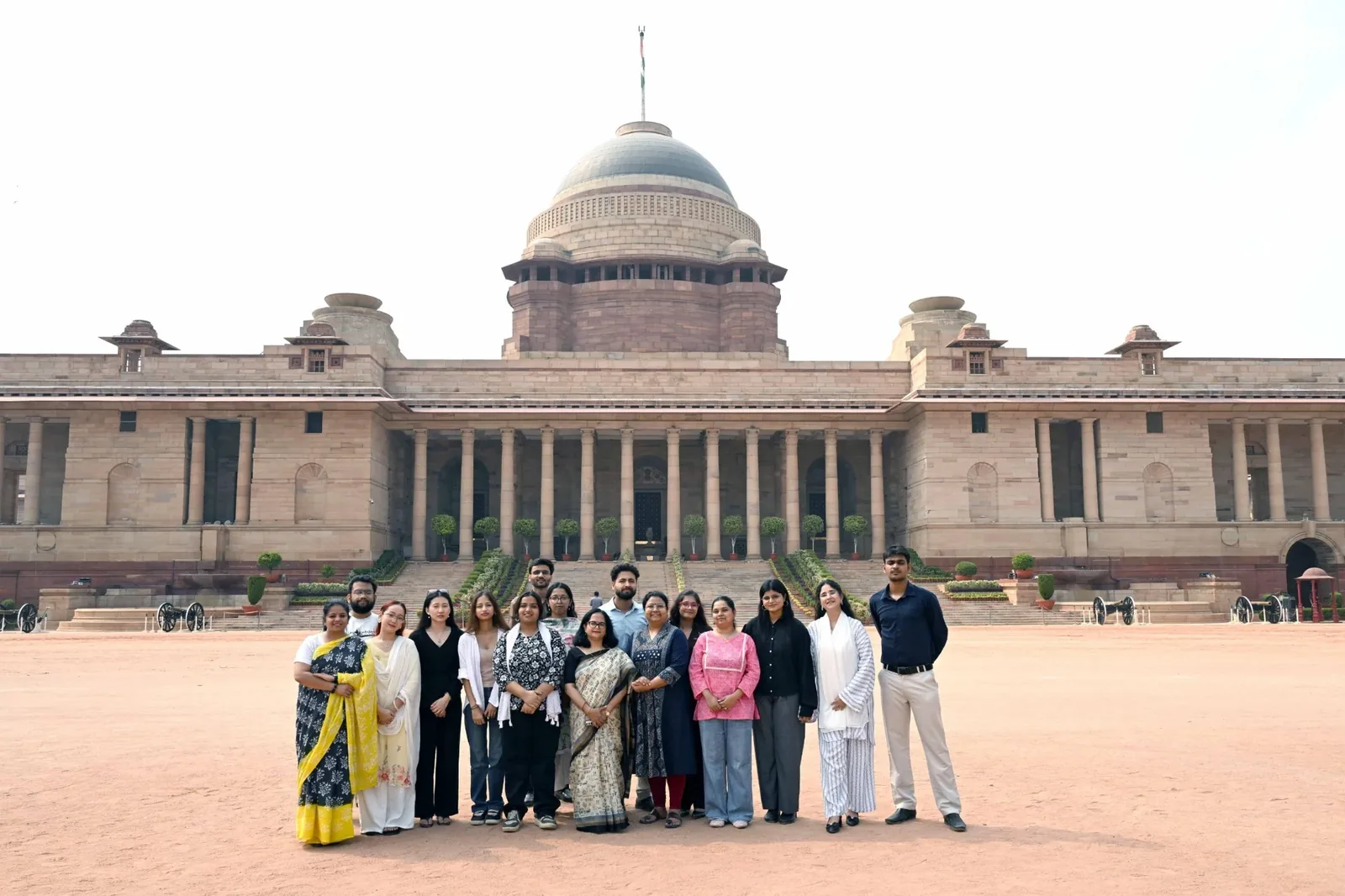
What happens when you trade the chaos of Delhi's vibrant and bustling streets to the quiet grandeur of the Rashtrapati Bhavan. Last Friday, I had the opportunity to visit one of India's most historic landmarks, the official residence of the President of India.
Now, Delhi has a special talent for making you late. The traffic tests your patience, the weather tests your commitment, and the sheer unpredictability of the city tests your faith with every ETA that Google Maps throws at you. But every once in a while, the city gives you a reason to forget all the chaos. Our visit to Rashtrapati Bhavan was one such occasion. When you're finally inside the premises, standing at the forecourt and gazing at the iconic H-shaped mansion, the chaos outside seems a world away.
However, one cannot simply walk in and announce their arrival at the Rashtrapati Bhavan. A visit requires advance booking, identity verification, and multiple security checks. But once you're past all that, the journey of experiencing India's history, heritage, and democratic traditions begin. We were fortunate enough to have been the guests of Former Press Secretary to the President, Mr. Ajay Singh, who helped us arrange the passes and a scholar guide to accompany us. And hence began our journey, not merely as visitors but also as curious observers of the stories its walls and corridors had to tell.
Rashtrapati Bhavan is not just a monument perched atop the Raisina Hills in New Delhi. It's a silent survivor of the colonial past and a true witness to the largest democracy in the world. The first thing that strikes you about the Rashtrapati Bhavan is its sheer scale. The workforce of 23,000 labourers which included 3000 labourers who were specialised stone-cutters; the red and cream sandstone monuments is an architectural marvel by Sir Edwin Lutyens. It has approximately 340 rooms spread across four floors, with nearly 2.5 kilometres of corridors. The main building occupies around five acres, within a sprawling 330-acre estate, of which approximately 190 acres are gardens. Visitors do not get to wander wherever they please as public tours follow designated routes. These include selected spaces, rooms, halls, and interiors.
After a brief introduction of Smt. Droupadi Murmu, 15th and serving President of India, we started our journey of the Rashtrapati Bhavan with the blessing of Lord Buddha or Sahastrabahu Avalokiteshvara (Lord of Compassion), displayed on the south ash-grey marble staircase that leads to the Gantantra Mandap. The sculpture was gifted to India's second President, Dr. Sarvapali Radhakrishnan, by the Govt. of Vietnam in 1962, to honor the deep spiritual and civilizational ties of the two countries.
From here, we moved towards the Gantantra Mandap, previously called the Durbar Hall. It was renamed by President Smt. Droupadi Murmu back in July 2024. It is located directly underneath the central double-dome, inspired by the Sanchi Stupa and serves as the venue for national functions, swearing-in ceremonies, including the presentation of National awards. It's here that Jawahar Lal Nehru took oath as Independent India's first Prime Minister. At the centre of this hall stands the 5th century Gupta-era Lord Buddha statue. What's even more fascinating is that if you draw a perfect straight line from the centre of the India Gate, it runs directly down the Kartavya Path, cuts cleanly between the North and South Block, and pierces the exact centre of the Gantantra Mandap. That's not all, the deliberate architectural genius of Sir Edwards Lutyens is such that the base and feet of Lord Buddha statues sit at the exact same altitude as the top of the India Gate.
As we walked past the busts of former Presidents, we were reminded of the great men and women who've shaped the country we live in today. Each name represents a different chapter in India's political history and their legacies that extends far beyond their years in the office.
Rashtrapati Bhavan has seen several additions over the years and many of them at the initiative of the Presidents who've assumed office at the time. One such addition is the Granth Kutir, inaugurated by President Droupadi Murmu on January 23, 2026. A library of India's 11 officially recognised classical languages. Granth Kutir houses a collection of more than 2300 books in Assamese, Bengali, Sanskrit, Kannada, Malayalam, Marathi, Pali, Prakrit, Odia, Tamil, and Telugu. It also houses a rare collection of 50 manuscripts hand-written on palm-leaves, paper, and tree-bark, showcasing India's rich history and culture. In a building so closely associated with India's colonial past, Granth Kutir offers an interesting contrast.
There's also the Ashok Mandap, previously known as Ashoka Hall. The large room is used as a place of introductions for the visiting and Indian delegations. It was used as a ballroom in earlier times and you can still feel the wooden flooring attached with springs when you take a step inside. And when you look up, at the centre of the ceiling is a leather painting of the second of seven Qajar rulers of Persia, Fath Ali Shah. He can be seen hunting a tiger in the presence of his twenty two sons. The painting carries a spellbinding effect or an optical illusion of sorts wherein the eyes of Fath Ali Shah appear to be looking at the viewer regardless of wherever they stand in the room. This is something similar to the three-dimensional effect seen in the Monalisa painting.
As we moved ahead, the architecture and grandeur of Rashtrapati Bhavan became even more apparent. While the building broadly follows colonial architecture, it also incorporates Indian elements. The use of Indian motifs is clearly visible. Chajjas, Chattris, and Jali work form an intricate part of building's design and aesthetics. It was difficult not to think of the Presidents, Prime Ministers, award recipients and other public figures who had walked through these very halls over the years. Standing there as a visitor, it was a unique experience and something that stayed with me throughout the course of the visit.
As our journey through the halls of the Rashtrapati Bhavan continued, it became clear that the building was not just an institutional landmark but a place that served several purposes at once. The official resident of the President, venue for important ceremonies, and a place where visiting dignitaries are welcomed and hosted. The Banquet Hall or the State Dining Room inside the Rashtrapati Bhavan also had its own charm. When dignitaries dine, the President's Naval Band performs in the background, adding a touch of elegance to the evening. More recently, President Smt. Droupadi Murmu has also introduced classical music to the dining experience, bringing another layer of Indian cultural tradition into the room. Previously, the music performances used to happen from the gallery above the dining area. Today, however, the bands stand at either corner of the hall, on the left and right of the entrance, allowing the music to fill the space from both sides.
It also houses a highly valuable collection of antique Zardozi textiles, gold-embroidered carpets, and historic artifacts inside the Sutra-Kala Darpan Gallery located within the walls of the Rashtrapati Bhavan. As we walked through more corridors, we found ourselves stopping and pausing before the portraits of former Presidents that lined the wall. The Param Vir Dirgha left us with the same feeling. Inaugurated in December last year, the gold-plated ceiling of the corridor lined the 21 Param Vir Chakra awardees. Each portrait served as a reminder of extraordinary courage and sacrifice.
By the time we reached the end of our visit, we stopped one last time to marvel at the bust of Chakravarti Rajagopalachari, independent India's first and only Indian Governor-General. The bust is installed at the Grand Open staircase near Ashok Mandap, opposite to Mahatma Gandhi's statue. As we walked towards the open-area, it only felt fitting to end the visit with a leisurely stroll through the gardens of Rashtrapati Bhavan, surrounded by greenery and with memories to cherish for a lifetime.